The Power of Lifestyles Icons: Visual Language for Modern Digital Experiences
In our increasingly visual world, a simple icon can speak volumes. From the smartphone apps we use daily to the websites that inform and entertain us, icons are the silent guides that streamline interaction and enhance understanding. A specialized set, such as Lifestyles icons, serves a unique purpose: encapsulating the essence of daily life, hobbies, activities, and personal pursuits into clean, immediate visual symbols. This article explores the significance of these icons, their practical application across various media, and why a well-crafted set is a vital asset for designers, developers, and content creators aiming to connect with a general audience.
What Are Lifestyles Icons?
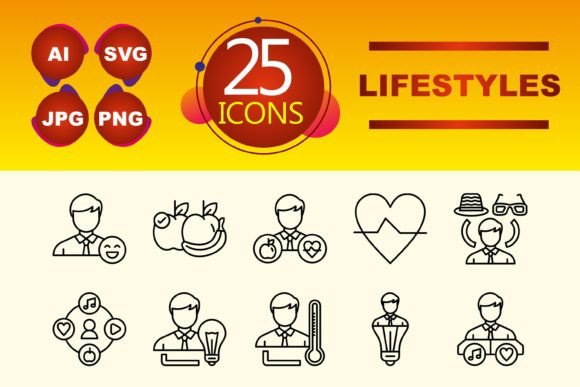
At their core, Lifestyles icons are a curated collection of graphical symbols representing themes related to personal life, leisure, wellness, and everyday activities. Unlike generic UI icons for settings or downloads, these icons depict concepts like travel, fitness, reading, music, family, food, or relaxation. The specific set described here—offering 10 icons in a Line Icon style—provides a focused toolkit. The "Line" style refers to icons created primarily from strokes or outlines, resulting in a clean, minimalist, and often modern aesthetic that is highly versatile and easy to integrate.
From Symbol to Understanding: The Purpose of Niche Icon Sets
The purpose of a dedicated Lifestyles icon set goes beyond mere decoration. It addresses a fundamental need for contextual communication. In a mobile app about health coaching, a simple line icon of a runner instantly signals a fitness tracking feature. On a website for a vacation rental service, an icon of a beach umbrella quickly denotes properties near the shore. These icons serve as intuitive visual anchors, reducing cognitive load for the user. They bypass lengthy textual descriptions, making interfaces faster to navigate and information easier to digest, especially for beginners exploring a new platform or topic.
Significance and Practical Relevance Across Platforms
The true significance of these icons lies in their remarkable adaptability. Their provided file formats—AI, JPG, PNG, and SVG—are the key to this flexibility, ensuring they fit seamlessly into the fabric of modern digital creation.
- Mobile Apps: In app design, space is premium and user attention is fleeting. A set of clear Lifestyles icons can define feature categories, label navigation tabs, or illustrate tutorial steps, enhancing the overall user experience (UX) and making the app feel more personal and engaging.
- Website Templates: For websites, icons break up text-heavy content, improve scannability, and reinforce thematic sections. A blog about "balanced lifestyles" can use these icons to visually categorize posts about nutrition, mindfulness, and travel, guiding readers naturally.
- Presentations & Infographics: Here, icons are storytelling tools. In a business presentation on market demographics, lifestyle icons can visually represent consumer hobbies. In an educational infographic about daily habits, they transform statistics into relatable, memorable visuals.
- User Interface (UI) Design Templates: For designers building UI kits or wireframes, having a coherent set of Lifestyles icons speeds up the prototyping process, ensuring visual consistency and allowing clients to grasp the concept's functionality immediately.
Clarifying a Common Misunderstanding: Icons Are Not Just Art
A common assumption is that icons are primarily aesthetic elements. While good design is crucial, their foremost role is functional communication. A poorly chosen or ambiguous icon can confuse users more than text. For instance, an icon meant to represent "meditation" should be universally recognizable—perhaps a figure in a serene pose—not an abstract shape that could be misinterpreted. The 10-icon set focuses on core lifestyle themes, which reduces the risk of ambiguity and ensures each symbol carries a clear, intended message.
Building a Broader Understanding: Icons in the Context of Modern Life and Technology
Lifestyles icons fit perfectly into the narrative of how technology mediates our daily activities. They are the bridge between digital interfaces and our real-world interests. As we manage more of our lives through apps and websites—planning workouts, booking trips, tracking diets, learning hobbies—these icons become the familiar visual touchpoints that make digital tools feel less technical and more human-centric.
In business and education, they facilitate clearer communication. A startup creating a community platform for gardeners can use plant or nature-themed lifestyle icons to foster immediate recognition and belonging. An online course platform can use icons to differentiate course categories like "Creative Writing" (pen icon) from "Home Cooking" (chef's hat icon), aiding student navigation and choice.
The Technical Advantage: Multiple File Formats Explained
The inclusion of specific file types (AI, JPG, PNG, SVG) is a practical feature that speaks to both creativity and technology. Each format serves a distinct purpose:
- AI (Adobe Illustrator): This is the editable source file. It allows designers to modify colors, strokes, or scale without quality loss, offering complete creative control for custom projects.
- SVG (Scalable Vector Graphic): Crucial for modern web and app development. SVGs are vector-based, meaning they scale to any size perfectly without becoming pixelated. They are also lightweight and can be animated or styled with CSS.
- PNG & JPG: These are raster formats, useful for static images in presentations, documents, or social media graphics where vector editing isn't required. PNG supports transparency, which is invaluable for overlaying icons on varied backgrounds.
This multi-format approach ensures the icons are ready for any project stage—from initial design conception in Illustrator (AI) to final implementation in a live website (SVG) or a printed marketing brochure (JPG/PNG).
Examples in Action: Bringing Lifestyles Icons to Life
To understand their utility, consider these natural examples:
A travel planning website uses a suitcase icon for "My Trips," a mountain icon for "Adventure Tours," and a food icon for "Local Dining Guides." Users instantly grasp the site's structure.
A personal wellness mobile app employs a moon icon for sleep tracking, a heart icon for mindfulness sessions, and a bicycle icon for activity logging. The app's holistic approach is communicated visually from the first launch.
An educational presentation for a financial literacy workshop uses a home icon to represent "Budgeting for Housing," a book icon for "Educational Savings," and a tennis icon for "Budgeting for Leisure." Complex financial topics are made relatable and segmented clearly.
Emphasizing Context and Cohesion
The value of a cohesive 10-icon set is its ability to create a unified visual language. Using scattered icons from different sources can result in inconsistent style, varying line weights, and disjointed user perception. A dedicated set guarantees that all icons share the same artistic DNA—the same line thickness, detail level, and stylistic approach—creating a professional, polished, and trustworthy feel across the entire project. This cohesion is vital for brand identity and user trust, aligning with SEO and content principles that value high-quality, user-focused experiences.
Conclusion: Small Symbols with a Broad Impact
Lifestyles icons, particularly in a versatile Line style with comprehensive file formats, are more than just digital assets. They are essential tools for effective visual communication in an era dominated by screens and swift interactions. They make digital environments more intuitive, content more engaging, and complex offerings more approachable for all readers and users, from beginners to experts. By encapsulating the facets of our daily lives into simple, elegant symbols, they help designers and creators build interfaces and content that resonate on a human level, ultimately enhancing how we learn, work, manage our lives, and interact with technology every day.