The Unseen Language of Professional Modelling: The Role of Design Iconography
Within the competitive and visually-driven world of modelling agencies, communication extends far beyond photographs and portfolios. Every touchpoint, from a website interface to a client presentation, needs to convey professionalism, precision, and aesthetic sensibility. While a stunning model is the central asset, the surrounding digital and presentation materials form the critical framework that supports that asset. This is where a specialized set of design elements, like a curated collection of modelling agency icons, becomes an essential, albeit often overlooked, tool for brand cohesion and operational clarity.
Translating Abstract Concepts into Visual Symbols
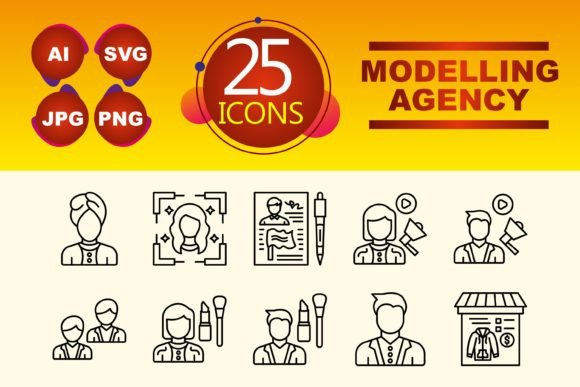
A modelling agency manages a complex ecosystem of talent, clients, bookings, and logistics. Communicating these facets quickly and elegantly in digital spaces is a unique challenge. Generic UI icons may not capture the specific nuances of the industry. A dedicated set, featuring ten line icons tailored to modelling agency themes, acts as a visual shorthand. Imagine an icon representing a portfolio, not as a generic folder, but as a stylized silhouette or a sleek photo frame. An icon for a booking or schedule could be a calendar integrated with a figure, suggesting a model’s appointment. These symbols translate abstract operational concepts into immediate, recognizable visuals.
This visual translation is not merely decorative. It enhances usability. For an agency’s internal management software, icons for "model onboarding," "contract status," or "client feedback" can streamline navigation for staff. On a public-facing website, icons guiding potential talents to "application steps," or clients to "service categories," create a more intuitive and engaging user experience. The clean, minimalist nature of line icon styles aligns perfectly with the sophistication the industry projects, avoiding visual clutter while delivering functional meaning.
Core Characteristics of Effective Agency Icon Sets
An effective icon set for this sector possesses distinct characteristics. First is relevance. Each icon must map directly to a common agency function or entity: talent profiles, photo shoots, contracts, fashion shows, measurements, communications, and location or venue markers. Second is cohesive style. The consistent use of line art—defined by strokes of uniform weight, minimal detail, and open forms—creates a unified visual language across all applications. This consistency reinforces brand identity. Third is technical versatility, ensured by the provision of multiple file formats.
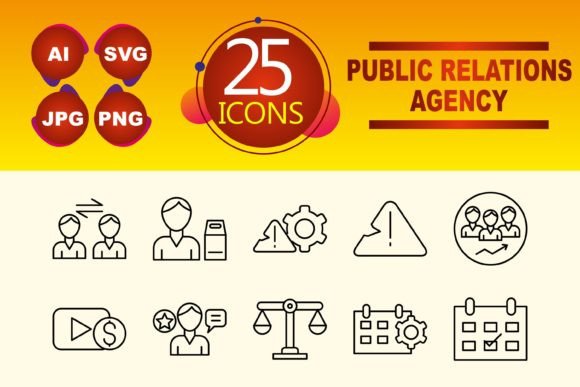
The inclusion of AI (Adobe Illustrator), JPG, PNG, and SVG files addresses diverse implementation needs. SVG files allow for scalable, resolution-independent use on websites, ensuring crisp display on any device. PNG and JPG files offer ready-to-use raster images for presentations or quick graphic placements. The AI source file provides ultimate flexibility for designers to customize colors, stroke weights, or combine elements, allowing the agency to adapt the icons to specific campaign themes or brand color palettes without losing the core design integrity.
Broad Applications Across Professional Touchpoints
The utility of such a specialized icon collection spans the entire spectrum of an agency’s professional activities. For mobile applications, whether a client app for booking talent or a model app for managing schedules, these icons provide a clear, space-efficient navigation system. Their simplicity ensures they remain legible on small screens. In website templates, they can be used to highlight key services, feature testimonials with visual cues, or create an elegant, icon-driven footer for contact information.
Presentations to fashion brands or advertising clients benefit greatly. Instead of bullet points listing services, an agency can use these icons to create a compelling visual storyboard: an icon for "casting" followed by one for "shot production," then "digital delivery." This makes the process tangible and memorable. For infographics explaining the agency’s success metrics—like the number of models placed in different market sectors—relevant icons can categorize data visually, making complex information accessible.
Perhaps one of the most significant uses is in user interface design templates for internal tools. Agencies often use custom software for model databases, casting calls, and financial tracking. Implementing a consistent icon set across these platforms reduces training time for new staff and minimizes cognitive load, as the symbols become familiar markers for specific tasks and data types. This fosters efficiency in a fast-paced business environment.
The Strategic Advantage of a Unified Visual System
Adopting a dedicated icon set offers strategic advantages beyond mere aesthetics. It builds a stronger, more recognizable brand identity. When the same visual symbols appear on the website, in pitch decks, and on internal dashboards, it creates a subconscious thread of professionalism and reliability. It demonstrates attention to detail, a trait highly valued by both models seeking representation and brands seeking partners.
Furthermore, it enhances communication efficiency. In a global industry, where collaborations happen across languages, well-designed icons can serve as universal cues, reducing misunderstandings. A clear icon for "contract signed" or "payment processed" in a management system conveys status instantly to any user, regardless of linguistic proficiency. This operational clarity can reduce administrative errors and streamline workflows, contributing directly to business performance.
Considerations for Selection and Implementation
When evaluating or implementing such an icon set, agencies and designers should consider several factors. The scope of ten icons is concise; it’s crucial that the selected icons cover the most critical, high-frequency concepts for the agency’s specific focus. A high-fashion agency might prioritize icons for "runway" and "editorial," while a commercial agency might need icons for "corporate casting" and "product showcase." The style should be scrutinized: line icons should be balanced, with strokes neither too thick to feel heavy nor too thin to disappear on certain backgrounds.
Implementation requires thoughtful integration. Colors should be chosen to align with brand guidelines, but often line icons work best in a single, strong color or against a contrasting background for maximum impact. Placement is key; icons should support text, not replace it entirely, unless in universally understood contexts like navigation bars. The SVG format’s advantage for web use is its editability; an agency can, for instance, animate an icon on hover to enhance interactivity on their website, making the experience more dynamic.
Ultimately, a modelling agency icon set is more than a collection of graphics. It is a component of the agency’s visual communication infrastructure. By investing in a coherent, industry-relevant set of symbols available in versatile formats, an agency sharpens its digital presence, optimizes its internal operations, and presents a unified, professional face to the world. It speaks the language of the industry in a clean, modern dialect, ensuring that every interaction, from a model’s first login to a client’s final pitch, is framed with clarity and style.