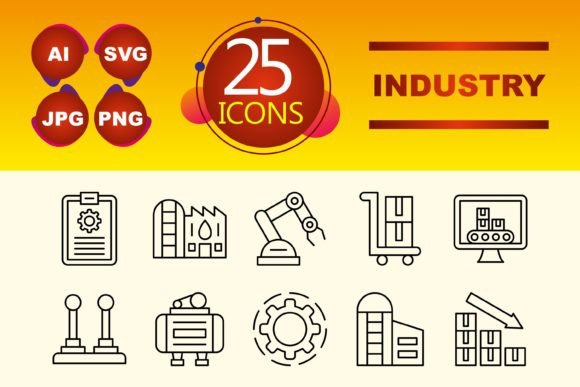
Industry Icons: A Versatile Toolkit for Modern Visual Communication
In the world of digital design, clarity and speed are paramount. Whether you're guiding a user through an app, illustrating a presentation slide, or creating a website footer, the right visual shorthand can communicate complex ideas instantly. This is where a focused set of Industry icons becomes an indispensable asset. Far from being generic symbols, these icons represent the foundational concepts of production, manufacturing, logistics, and technology—the very engines of the modern economy.
The Power of a Curated Collection
A well-designed set of ten Industry icons offers more than just images; it provides a cohesive visual language. When each icon shares a consistent Line Icon style, they create a sense of unity and professionalism. This consistency is critical when icons are deployed across different materials, from a mobile app screen to a printed infographic. The included file types—AI for unlimited vector editing, JPG for quick placements, PNG for transparent web use, and SVG for scalable, crisp responsiveness—ensure that this toolkit adapts to your workflow, not the other way around.
Consider the practical advantage. A blogger writing about supply chain innovation can embed an SVG factory icon directly into their article header for immediate thematic recognition. A startup founder crafting a pitch deck can use the clean AI files to customize a conveyor belt icon with their brand colors, integrating it seamlessly into their company's story. The efficiency gained by having a versatile, multi-format set removes a common creative bottleneck.
Creative Applications Across Professions
The utility of these icons stretches far beyond their literal industrial meanings. Their abstract, line-based forms invite interpretation and adaptation for a wide array of projects.
For User Interface & App Design
In mobile or web applications, these icons can label key functions. A "gear" or "factory" icon might intuitively represent a settings or configuration panel. A "transport" or "warehouse" symbol could perfectly denote a logistics tracking module within a business management app. The line style ensures they remain legible even at small sizes, a crucial factor for UI clarity. By maintaining a consistent icon style alongside your brand's typography and color palette, you build a trustworthy and polished user experience.
Enhancing Educational & Presentation Materials
Educators and corporate trainers can use these icons to break down complex processes. A flowchart in a presentation on lean manufacturing becomes more engaging when each step is marked with a clear, symbolic icon—a "robot" for automation, a "tool" for quality control. This visual scaffolding helps audiences follow and retain information. For infographics aimed at the general public, these icons can demystify industry topics, making data about energy production or global trade more accessible and less intimidating.
Branding & Marketing for Small Businesses
A freelance web designer building a site for a local machining workshop can use these icons in the services section. A "assembly" or "precision" icon next to a bullet point list conveys expertise faster than text alone. Marketers can incorporate them into email campaign graphics or social media posts to highlight industry-specific services. The key is to use them as supportive visual elements that reinforce your message, not distract from it. Always ensure the icon's connotation aligns with the surrounding text to avoid confusion.
Adapting Icons for Your Specific Audience
The successful use of any visual asset depends on understanding who will see it. The same industry icon set can be adapted to serve vastly different audiences.
For a technical audience of engineers or industry professionals, icons can be used more literally and densely. In a detailed technical whitepaper, icons might serve as repeated visual anchors for sections like "Materials," "Process," and "Output." Their meaning can be precise and assumed.
For a general audience or consumers, the approach should be more explanatory and supportive. Here, icons act as friendly guides. A "factory" icon on a community webpage about local industry might be paired with a clear headline like "How We Make Our Products." The icon provides a welcoming point of entry into the topic.
Entrepreneurs and creators might see these icons as raw materials for their own brand identity. By customizing the colors or subtly modifying the line shapes in the AI file, they can create a unique set that feels owned, moving from a generic resource to a bespoke brand element.
Maintaining Effectiveness and Originality
With any commonly available resource, the challenge is to use it in an original way. Avoid simply scattering icons across a layout. Instead, think of them as part of a system.
Establish a rule for their use. For example, decide that an icon will only appear to introduce a new major section, or only alongside statistics. This intentional restraint prevents visual clutter. Furthermore, leverage the variety of file formats to ensure quality. Use the SVG files for all web implementations to guarantee sharpness on high-resolution displays. Use the AI source files to create subtle variations—perhaps altering line weight or combining two icons into a new, custom symbol for your specific project—adding a layer of originality to the foundational set.
Ultimately, a concise set of Industry icons in a clean Line style is a tool for efficient, effective communication. It empowers designers, marketers, educators, and business owners to convey ideas of production, innovation, and process with visual speed and coherence. By selecting them intentionally, adapting them for your audience, and integrating them systematically into your projects, you turn a simple collection of symbols into a powerful component of your creative vocabulary.