No Code: Your Visual Toolkit for Modern Creation
In the digital age, the desire to build—to create apps, websites, or compelling presentations—is universal. Yet, the barrier of complex programming often feels insurmountable. This is where the philosophy and practice of No Code enters, transforming ambition into accessible action. More than a trend, it represents a fundamental shift in how we approach digital projects, empowering those without technical backgrounds to visually construct their ideas.
Understanding the No Code Movement
The core principle of No Code is elegant simplicity: enabling creation through intuitive interfaces, drag-and-drop components, and visual logic, bypassing the need to write traditional code. Think of it as building with smart, pre-designed blocks rather than crafting each brick from raw clay. This approach democratizes digital development, placing the tools directly into the hands of designers, entrepreneurs, marketers, and visionary individuals.
At its heart, No Code is about abstraction. It wraps complex functionalities into manageable, visual elements. This doesn't eliminate the underlying logic but presents it in a way that is easier to understand and manipulate. The value is immense, offering a faster path to prototyping, testing ideas, and deploying functional projects without the steep learning curve of software development.
Where No Code Icons Fit Into Your Workflow
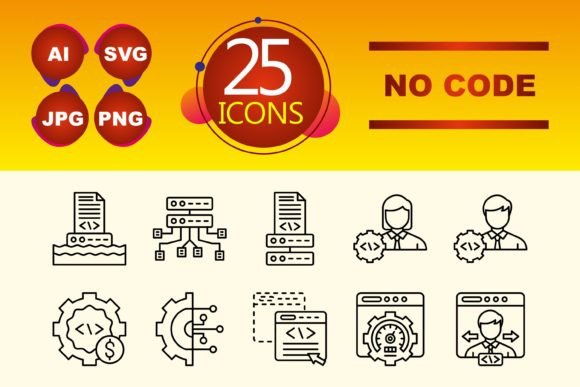
Visual communication is a cornerstone of the No Code experience. Every interface, template, or presentation relies on clear, recognizable symbols to guide users and convey function. A specialized set of No Code icons serves as this essential visual vocabulary. Designed to represent concepts like automation, workflows, drag-and-drop actions, and data connections, these icons become the silent narrators of your project.
This particular set, featuring 10 icons in a clean Line style, is crafted for coherence and clarity. The Line icon aesthetic, with its minimalist and precise strokes, aligns perfectly with the modern, uncluttered look sought in No Code platforms. Available in multiple file formats—AI, JPG, PNG, and SVG—ensures they integrate seamlessly into any stage of your creative process, from initial design mockups in Adobe Illustrator to final implementation on a live website.
The Versatile Applications of No Code Assets
The utility of No Code resources extends far beyond a single use case. They are the versatile components in a creator’s toolkit.
- Mobile App & Website Templates: Use the icons within prototype designs built on No Code platforms to visually map out user journeys, denote buttons, or explain features.
- Presentations & Pitch Decks: When explaining the No Code approach to stakeholders or clients, these icons provide professional, conceptual visuals that enhance understanding.
- Infographics: Chart the steps of a No Code workflow or compare development methodologies using icons as intuitive landmarks.
- User Interface Design: For designers crafting interfaces for No Code tools themselves, these icons can serve as part of the tool’s own iconography, creating a consistent user experience.
- Educational Content: Tutorials, blog articles, or online courses about No Code can use these icons to illustrate key concepts and break down complex ideas visually.
Who Benefits from Embracing No Code?
The audience for No Code is broad and diverse. General consumers with a project idea finally have a starting point. Professionals like consultants or agency owners can quickly build client portals or tools. Creators and bloggers can develop custom interactive elements for their audiences. Business owners can internalize processes by creating simple operational apps without relying on expensive developer contracts. Essentially, anyone with a problem to solve or an idea to express online can find a pathway through No Code.
Evaluating No Code for Your Project
While powerful, No Code is not a universal solution for every digital challenge. A practical evaluation of its suitability is key.
Consider its strengths: speed, cost-effectiveness, and accessibility. You can move from idea to a working model in days, not months, with significantly lower financial investment. This allows for rapid iteration—you can test, get feedback, and adjust without monumental sunk costs.
However, understand its considerations. No Code platforms often operate within defined boundaries. You may encounter limitations in:
- Customization Depth: Extremely unique or complex functionality might be beyond the platform's pre-built capabilities.
- Scalability: Some solutions may have performance constraints as user numbers or data volumes grow very large.
- Platform Dependency: Your project lives within the ecosystem of the No Code tool you choose, which can affect long-term portability.
The guidance is simple: match the tool to the task. Use No Code for prototyping, for MVPs (Minimum Viable Products), for internal tools, for marketing sites, and for projects where speed-to-market is crucial. For massively scalable, deeply unique core software products, traditional development may still play a role. Often, a hybrid approach—using No Code for rapid front-end development and integrating with coded back-end services—is the most pragmatic strategy.
Real-World Scenarios: No Code in Action
Imagine a local bakery wanting a custom loyalty app. Using a No Code app builder, they visually design the interface, using No Code icons for features like a "digital punch card" and "reward tracker." They connect a database for customer accounts and deploy the app, all without writing a single line of code.
Consider a freelance graphic designer who needs a portfolio website with a complex project filter. Using a No Code website builder with dynamic content features, they construct this filter visually, employing icons to represent different design categories (like "Logo," "Packaging," "UI"). The site is live and functional in a weekend.
These scenarios highlight the tangible impact: turning time and resource constraints into opportunities for innovation.
Moving Forward with Your No Code Journey
Embracing No Code begins with a shift in mindset. It’s about viewing digital creation as an assembly of intelligent parts rather than a mysterious art. Start by identifying a small, concrete problem you or your business faces. Explore the leading No Code platforms for that category—whether for apps, websites, or automation. Utilize resources like this set of No Code icons to give your designs professional clarity and conceptual accuracy.
Remember, the goal is not to replace developers but to expand the circle of creators. No Code empowers you to take the first draft, the prototype, the initial version into your own hands. It fills the gap between imagination and a tangible digital reality, providing a visual toolkit where your ideas are the only prerequisite.